Foreword: This article is the English translation of my original essay, written in Traditional Chinese, back in April 2025, roughly one year ago, when all we have about the anime adaptation is a promotion video. I chose to translate the essay into English now since the anime adoption is received quite well (from both people played the game and not played the game), and the Traditional Chinese article have unprecedented access traffic for such a small blog. This will not be a one-to-one translation of the Traditional Chinese version, mostly to streamline the essay and put focus differently for English-speaking audience; I’ll also incorporate some modifications reflecting the change of things within this year and the anime, but bear in mind the timeframe of the original essay is about a year ago, when we just heard of the anime adoption and only have one promotion video. This is a REALLY long essay (my word count plugin says this has almost 13K words) so enjoy!
Also sorry for the site still in Traditional Chinese; I only occationally post English stuff here.
Spoiler note: This essay contains discussion of the whole game, including the True Ending; the anime adoption goes in a rather different direction before converge into the True Ending, so some discussion will be different. I would suggest the reader either finishes the game or finishes the anime before reading this essay to avoid major spoilers.
Last Chinese New Year1 going back home, I prepared the game GNOSIA in my Nintendo Switch as the filler game between family activities. This title is actually sitting in my Steam wishlist for a long time waiting for it to come to PC, but after some consideration I decided to buy the Switch version:
- The genre of this game is known as Mafia or Werewolf, which I am quite familiar with. I was introduced to a genre of anime called “loop fiction” from Higurashi: When They Cry around 2007, then later from the When They Cry community (especially the Umineko fanbase) I was introduced to the Werewolf game. The variant I played the most is the Japanese web version written in PHP, called “汝は人狼なりや?” (Nanji wa jinrou narya?, literally translated as Are you werewolf?, henceforth shortened as Jinro), which I was introduced by this community following Niconico Douga videos featuring the Umineko characters “playing” this game. I’ve been in one of the Traditional Chinese Jinro community ever since, even after some decline when many of the members were too busy IRL and only holding the community together with the in-game chatroom.
- At the end of 2024 an anime adoption of this game is announced, and later revealed it will be on air in October 2025. Because of the familiarity with this genre, I decided to play the game first before anime airs.
- The reason to choose Switch version over PC version is twofold: I recently bought Switch (yes, just before Switch 2 announced), and as some basic info I gathered indicated, this game should be easily picked up and put away; there’s no need to stick before my PC to play. Although I may buy this game again on Steam for the achievements.
Here’s the overall gameplay of GNOSIA: on the first sixteen or so loops, the game gradually introduces to the player all the roles of the game and all 14 characters; in later loops the player will need collect background information of these characters, to find out why they (and Setsu) is trapped in this time loop.
During the research of this essay, I found an interesting record of this game: In Dengeki Indie Game Awards 2022, held by the Japanese column Dengeki Indie from the website Dengeki Online, which is voted by (I think) the readers of the column, GNOSIA had a grand slam of all the first places, even acquired the first four places in the Character Department! If you think the other titles in the overall department are already really good (OMORI in second, DDLC+ in third, ENDER LILIES in fourth), you should definitely try this game.
Rules of the Game
This genre of social deduction game starts from Mafia, created in 1986 by Dimitry Davidoff, where the two camps are Mafias and Civilians; the current “Werewolf vs Human” narrative is said to come from Andrew Plotkin. The basic form of the game is: the players are divided into two camps, one with fewer player but knows who are on their side (the “Werewolf/Mafia” side), the other with more player but don’t know who are the enemies (the “Human/Civilian” side). During the game, there are two phases in each round: the “day” phase, where the players still in the game discuss and vote to decide who will be removed from the game, and the “night” phase, where the Werewolf side decide who to eliminate from the game.
Over the course of 40 years of the game existing, there are many kind of variant popping out; the variant used by GNOSIA (and also Jinro) lean more heavily on the logical aspect, with the distinct feature of way more player capacity: In Jinro, there should be at least 8 players to start a game (which is relaxed to 5 in GNOSIA for narrative and introduction reasons); the basic form required 15 players (which is also the setting used by GNOSIA); and it is not until more than 20 player are there more twisty roles that adds to the complexity. As a comparison, other variants usually either requires no more than 10 player (like the Chinese variant 狼人殺 Lan Ren Sha), or use some wildly different set of roles on the get go (like Town of Salem or The Werewolves of Millers Hollow), which put more emphasis on the interactions between players. In our variant, with this many people involved, the focus of the game is on sacrificing players for information, and the logic deduction from these information; the Werewolf side is then motivated to provide misinformation to muddle the water.
Here are the roles of GNOSIA: (As a note, I’ll be contrasting roles in GNOSIA with roles in Jinro throughout this whole essay, often mixing terms between them. I’ll try not to confuse the reader, but be wary of the sudden swap of terms.)
- Crew: The Villager (村人 Murabito) in Jinro. Human side, with the goal to remove all Werewolfs from the game by voting. In GNOSIA universe this removal is cold sleep, but in Jinro it is usually called hanging.
- Gnosia: The Werewolf (人狼 Jinrou) in Jinro. Werewolf side, knows who are the werewolves, can eliminate (usually called “bite” as they are “werewolves”) one player each “night” phase, with the goal to reduce the number of Human players to overpower them by number. In GNOSIA universe the eliminated player is disappeared, but in most other Werewolf variants (incluing Jinro) this is the werewolf attacked one human to death.
- These are the two basic camps of the game. The first loop of GNOSIA is a simple 5 player game, used to introduce the gameplay flow, therefore (and also for other reasons) the progress of this loop is fixed.2
- Because deciding who to hang/cold sleep is by a simple majority vote, there will be some rules regarding what to do when more than one player get the majority vote. Depending on variant, there are many ways to do this, including (a) eliminate all majority, (b) eliminate no one, (c) recast vote among the tied majority, or (d) recast vote among all the remaining players. Jinro uses option d, but declares the game drawn when the tie occurs too many times, while GNOSIA initially uses option c, but switch to option a or b after recasting becomes stalemate.
- Engineer: The Diviner (占い師 Uranai-shi) in Jinro. Introduced in Loop 2 in game. Human side, each “night” the Diviner can examine one other player to find out if they are werewolf or not. In GNOSIA universe, the Engineer is the person have the power to use the equipment on ship to examine the target.
- This role is (nearly the only) source of information for Human side, and therefore also the main misinformation from the Werewolf side. Loop 3 of the game almost will have two people claim the Engineer role, to tell the player “this is how the GNOSIA side player deceive us”. The importance of this role is further reinforced with the introduction of Bug/Kitsune (described below).
- Guardian Angel: The Hunter (狩人, Kariudo) in Jinro. Introduced in Loop 4 in game. Human side, each “night” the Hunter can choose one other player to defend them from being attacked by the Werewolf. In GNOSIA universe, the Guardian Angel achieved this by changing the warp timing of the target.
- As shown in Loop 4 by Stella, this role usually will not Step Forward, to confuse the Werewolf side whether they will succeed the attack on important Human roles. The possibility to Step Forward as Guardian Angel in GNOSIA is forbidden by system, but on larger games of Jinro there will be situations that the (un-)successfulness of some guard is an important information to be revealed, even at the cost of the player themselves.3
- In many variants of the Werewolf/Mafia games, there is a nerf to this role: one cannot guard the same person in two consecutive nights. I think this is to balance for fewer players, since with fewer players the Werewolf side does not have enough time/rounds to eliminate this role before eliminate their primary target; Nerfing this role will force the “hunter” player strategically change their defensing target depending on the situation. This is not the problem in Jinro and GNOSIA with much bigger player capacity, so there is no restriction on Guardian Angel; and it is also hinted to the player that the primary mission of Guardian Angel is to protect the Engineer they think is real, for the information they give is valuable.
- There is some terminology worth pointing out here: In this essay I’ll refer to this role as either Guardian Angel or Hunter, but in other variants this role may have other names like Knight, Doctor or Guard; just as Doctor in GNOSIA refers to another role, in other variants the role named Hunter may refers to another one with the ability to eliminate one player when they are voted out.
- AC Follower: The Madman (狂人, Kyoujin) in Jinro. Introduced in Loop 9 in game. Although belongs to Werewolf camp, all other aspect of the player count as Human (In GNOSIA this includes the result of Engineer and Doctor, and also the game end condition). Don’t know who are the Werewolves, and the Werewolves don’t know who is Madman. In GNOSIA universe, this is the Gnos followers that praises Gnosia to destroy the universe.
- This is a tricky role to play. The Human aspect of this role means this is the best source of misinformation from the Werewolf side, either claiming fake roles or guide the direction of discussion, but because the uncertainty introduced with claiming fake roles, on many occasion the strategy of the Human side will become hanging all remaining claimed roles after certain amount of time4, which means the survival rate of this role is also not good.
- Doctor: The Medium (霊能者, Reinousha) in Jinro. Introduced in Loop 10 in game. They can determine whether the voted-out player of the previous day is Human or Werewolf. In GNOSIA universe, this is the power to examine the person in cold sleep.
- Many variant of the game lacked such “wise-after-the-event” role, simply because this information is not that useful in fewer player situations; but if we have many player to spare, hanging up a few player that some Diviner said is werewolf can reveal the truthfulness of those Diviners. Jonas also explains this aspect of the role in Loop 10.
- Guard Duty: The Telepath (共有者, Kyouyuusha) in Jinro. Introduced in Loop 13 in game. Belongs to Human camp, and there will always be 2 (or more) player have this role, who knows each other. In typical Jinro setting, it is said that the Telepaths have mystery connection between themselves, so they can discuss at night in private (hence called Telepaths), while in GNOSIA universe they are the two people who stayed on ship when the Liu-An event happened.
- As introduced in Loop 13, even if LeVi can only confirm there are two people stayed on ship but cannot confirm it is definitely Remnan and Yuriko, they both said the other one is the person on ship with them, and also no other people objects the claim. This is enough to confirm that they are indeed the two people that stayed on the ship and are definitely not Gnosia.
- This setting is somewhat changed in anime adaption, as the identity of the two Guard Duties are announced by LeVi, possibly to streamline the plot.
- In bigger games with more than 20 players, there is a strategy involving not claim to be Telepaths early, but only claim so after being falsely identified as Werewolf by Diviner. The motivation is that, since they are definitely human, they can become the trap for exposing this kind of false identification; in GNOSIA it is a rare thing to have 4 people claiming Engineer5, but with more roles introduced in 20+ player games, 4 Diviners are quite common, and for even bigger game where there are two real Diviners in game, there will be typically 5 to 7 people claiming to be Diviners. As such, the probability of falsely identify a Telepath to be Werewolf become higher to the point that such trap strategy is acceptable in exchange of narrowing down the suspects early.
- Note that “no one objects the Guard Duty claim” is also an important aspect of the role; the previous strategy would gave the Werewolf player motivation to falsely claim to be Telepath as a counteract. Sometimes there will be some “out-of-game” proofs ensuring the Telepath claim is genuine: In Jinro, there is a setting to let Telepaths “send signal” as they speak privately at night to all the player, indicating some Telepath still alive (which can be turned off, giving a nerf to the role as stated), while in GNOSIA Guard Duty role cannot be falsely claimed. I think this is probably meant to streamline the play loop, and give new player some ground logic to stand on.
- As introduced in Loop 13, even if LeVi can only confirm there are two people stayed on ship but cannot confirm it is definitely Remnan and Yuriko, they both said the other one is the person on ship with them, and also no other people objects the claim. This is enough to confirm that they are indeed the two people that stayed on the ship and are definitely not Gnosia.
- Bug: The Kitsune (妖狐, Youko) in Jinro. Introduced in Loop 16 in game. Belongs to neither Human or Werewolf camp, this role seizes the victory when the end game result is decided and this role is still alive. It cannot be attacked by Werewolves (nothing will happen at night, although Kitsune will know Werewolves attacked), but when inspected by Diviner/Engineer it will “die” just like being attacked. In Jinro setting the Kitsune is said to be Cursed to death by the Diviner, while in GNOSIA universe it is the Engineer found out the inconsistency within the Bug so it is eliminated.
- This kind of a third camp is quite prevalent in many variants, especially if one counts those have unique victory condition roles as a generalized third camp (like the Tanner from One Night Ultimate Werewolf). Most of the time they only have one or two people, have unique way of winning besides the battle between the main two camps, and have special elimination rule about them. In Jinro/GNOSIA setting, the existence of this role motivates the Werewolf/Gnosia side to leave Diviner/Engineer alone at first, to let them have a chance to catch the Kitsune/Bug, as they cannot deal with this role themselves.
- As a role that the winning condition involved surviving, this role doesn’t have really high winning rate (about 10% to 15% in Jinro). Ability points in the game may help somewhat, but it is still not easy to secure a win. Case in point: in my own Loop 16, I got cold slept in the middle of the loop, and only properly unlocked this role in a later loop.
- As one may observe from the game, Kitsune/Bug has some motivation to claim some role. The motivation is that, usually Kitsune should not claim role to stay low for survival, but bears the risk of being found by Diviner/Engineer; Claiming some role is a way of hiding by inverting this thought of “must find the hidden enemy within peoples”, thus hiding in a place with almost no risk of being inspected, in exchange of the risk of falsely claim definitely human roles as Werewolf and the risk of Human players hanging all Diviners. One can view Kitsune claiming a role to be a more Werewolf camp leaning strategy, while not claiming a role be considered as more Human camp leaning strategy.
- Here are some interesting jargons used in my community regarding Kitsune. As mentioned in a Remnan event, when there are two players died at night, one of which would be attacked by Werewolf/Gnosia, and the other would be the Kitsune/Bug being inspected by Diviner/Engineer. For a false Diviner in Jinro, it is therefore of utmost importance to figure out the situation when seeing two corpses in the morning, change their prepared report accordingly on the spot. In the early days of Jinro coming to our community, this is called a “test” for the false Diviners, for they will want to react accordingly, or they “failed” this test and will be hanged; the Diviner that found the Kitsune while the other “failed” would then be “registered” as the real one. This verb “register” later would be extended to have the meaning of “(the Diviner) found the Kitsune”, the Kitsune itself is then called “registration form”, and the original “test” (changing the report on the spot) is now called “seizing the form”.6 In GNOSIA, false Engineers won’t be able to do such last minute report swap, probably to streamline the game flow, but this do tilt the balance toward Human somewhat: If an Engineer inspects neither disappeared characters in the previous night, that Engineer is definitely fake. Similarly, past reports generated for falsely claiming player is also probably streamlining the game with the expense of favoring Human side.
In addition to the subtle differences mentioned above, there are other rule differences between GNOSIA and Jinro:
- There is no such notion of “first night victim” in GNOSIA. In similar variants, the “first night victim” is the lore element of why the werewolf game begins, and mechanically it is also the target of the Werewolf players to justify a “night” phase before the first “day”. In Jinro, this first “night” phase is mostly for the groups that know each other (Werewolves and Telepaths) to discuss strategies, and giving Diviner the first inspection target as some basic discussion material; but in theory the Werewolf players should also be able to “eliminate” one player in this first night phase. This poor player that didn’t even have a chance to be involved in discussion is then called “first night victim”. In offline Werewolf games this role is often played by the game master for lore and pratical reasons; In Jinro, to spare players from joining the game but didn’t even get a chance to play, there is a non-player target that the Werewolf player can only attack on the first night. (In the original Japanese Jinro, this NPC player is called “dummy”, while in my community it is called “scrap”, a reference to the main protagonist of Shakugan no Shana being dead before the story begins, leaving only scrap.) In GNOSIA this “first night victim” thing is skipped and we go straight into the day phase discussion, but the Engineer does not have this one more check.
- There is one minor detail about the game system of Jinro. This “first night victim” is also an option that can be turned off, but the vast majority of the time it is turned on for the aforementioned reason. System-wise there IS a dummy player died in the first night, so the overall player count will include this “first night victim”; For example, the corresponding setting of full 15 players in GNOSIA is called a “16-player game” in Jinro. Other player count of Jinro games in this essay follow this convention, like the 20 player game mentioned above also includes the “first night victim”.
- There is no “last words” in GNOSIA. Often in online Werewolf games, players can edit a short message before death, and it is shown to all players when they are dead. This is called “last words” (遺書) in Jinro. Many information can pass to the alive players in this way, when it is disadvantageous to reveal while they are alive. In offline Werewolf games this may be achieved by giving the player just eliminated a brief moment to say something. There are several reasons why GNOSIA does not have this kind of mechanics: (a) it is hard to summarize the content of the last words, which may contains anything beyond suspecting someone; (b) the game is interrupted when the player is dead mid-game, so there’s no need for player to leave last words; and (c) even if the NPC characters left some word, they may still be lying, and player isn’t able to trust it.
- Interestingly, having “last words” or not is yet another option in Jinro. There are different strategies for playing a no-last-word game (for example, the Telepath hiding strategy is less effective in such games because of provability, and they should be more inclined to Step Forward early), and those are also applicable to GNOSIA.
- A minor victory condition difference between GNOSIA and Jinro: when deciding whether Gnosia/Werewolf win, in Jinro Kitsune are neither Human nor Werewolf, so when three players are alive with one Human, one Werewolf, one Kitsune, the game is set and Kitsune stole the Werewolf win; in GNOSIA Bug count as Human, which simplify the condition, but in situation like this the game does not end immediately.
- As mentioned above, the game is interrupted when the player is dead, so for the game system to consider it a win for player, the player needs to survive. This makes some roles like AC Follower quite hard to “win”, as being the primary source of misinformation they are the easy target of the other players. By comparison, in Jinro even if a player is dead, if their camp wins they still win, so a mainstream strategy for a Madman role is to claim Diviner early, spreading as much (mis)information as they can, even when they will be voted out early in the game most of the time.
Overall, although not perfectly, this game do invoke the memory of me playing Jinro one game every night all those years back. Speaking of which, let me talk a little more about game length: In a 16 player game, the time control setting is usually “4-minute day, 3-minute night”, which sets the discussion time of each phase; Each is followed by 2 minutes of time where player cannot discuss, only act (cast vote on day and action on night). This 2 minutes of action time is fixed, but the discussion time can be altered according to the player number expected. Overall, 9 to 11 minutes is used for each day round, and for a 16 player game which lasts 5 to 6 days typically, one game lasts about 1 to 1¼ hours; for those game that have more player, one game will last about 2 to 3 hours, which is not easy to arrange for such many player count.7 Compare this to GNOSIA, where the discussion is not by time but by the number of rounds speaking, and in the later stage player usually don’t act that much; the night time is almost none unless the player is Engineer or Gnosia. All in all, one game requires only about 15 minutes of time. This short turnaround time is one of the reason I chose the Switch version.
Abilities
This game characterizes the aspects of player of the game with the following six abilities:
- Charisma, how likely your comment is accepted by others. I sometimes conflate this stat with Charm, probably because of similar wording.
- Intuition, how likely you will spot the lies.
- Logic, how convincing your statement is, and also many logic related skills require this.
- Charm, how likely you are favored by others.
- Performance, how likely your lies will pass through. This is actually more influential than one might think, as almost anything a lying player said is affected.8
- Stealth, how unlikely you are being targeted.
The accumulation of player stat across the loop really mirror my experience of having hundreds of games of Jinro getting hang of the strategies, and the stats of other characters also build up with their respective personality told by the events. My first thought after finishing the game being “I’m getting to know these 14 people with these hundred odd games” summarizes the game system pretty succinctly.
Characters
Speaking with personality: In a setting with such a constrained space and time, there is not that many ways to develop the characters. As the main objective is to collect the stories of these 14 characters, I think it is also appropriate to let me go through them one by one, writing my own observations.
Let’s have Kukrushka as the first spoiler shield:
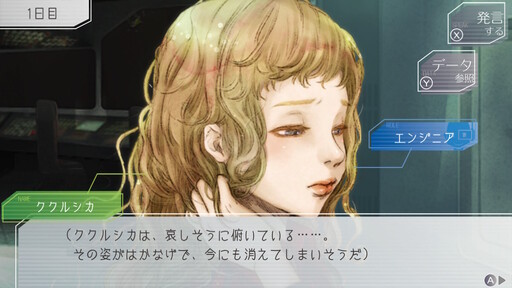
The order of the following is according to in-game crew data. I also attached the associated zodiac sign and color (according to the Steam achievements); I think I read from somewhere that this association will affect some initial parameter of the characters (except Kukrushka and Yuriko) with the player. (For those who are interested, my first player character is Female and White.)
Also, for a reason that’ll become clear later, I’ll henceforth use the name of the anime protagonist Yuuri to refer to the player character, but bear in mind I’m not discussing the anime Yuuri, who is a rather different character. (I spell their name with two u’s both to reflect the fact that the original Japanese spelling has a long vowel, and to distinguish them from Yuriko.)
Jina (Capricorn Purple)
Jina is an emotional person.
She is often seen looking out of window into the space (for example, in Loop 2 when she is about to introduce the Engineer role). Maybe partly because she’s a flight traffic controller, that need to stare into the void most of the time, but I’d like to think she’s also thinking about her past (with her mom back at Earth). Many of her habits (eg. likes Japanese food) probably comes from her trying to feel back at home.
Her emotional part also manifested into her game performance. Her fourth note says “Very intuitive, but not aware of this herself”; As a self-proclaimed half emotional person, I think this can be explained with this emotional part of her, that she is able to discern the “aura” of the others to subconsciously think “this person can/cannot be trusted”. I had once played in a game of Jinro where I am the latter of the two Telepaths to be bitten by Werewolf; at the day I step forward to lead the game (and subsequently be bitten that night), there are (unbeknownst to me at the time) two Werewolves and one Kitsune within the seven players alive, which means if the players voted one Human out in the remaining of the game, Humans will lost to either Werewolves or Kitsune. Players in Heaven9 already think the game will be a Kitsune win, but with the “feeling” I have of the texts on a previous discussion day regarding who to hang, I, the trusted Telepath, first asked everyone vote one suspect out (who turns out to be the Kitsune), left my two other suspects in my last word, and the discussion later successfully voted them out, who turns out to be the remaining two Werewolves, and secured a turnaround win. This kind of “intuition” is also what I observed from Jina in the later stage of the game.
And I think I must explain the name spelling. There are numerous sources I found regarding more settings of the characters10; one of the unconfirmed source says she is of Korean descent, and also her design is close to a Korean pop star. In Korean, “ㅈ” is romanized as J, not G, and I think this is why the Japanese version gave her J in the spelling. In this essay I’ll also spell her name with a J throughout.
SQ (Aries Red)
SQ is a person who does what she likes. The [REDACTED] SQ is also a person who does what she likes.
Those who reached the final ending will know the distinction I made here. Both of them can be described as such, with the former closer to Chaotic Good, and the latter closer to Chaotic Evil. Probably because of this, I cannot seem to form a good intuition on which SQ is which in game. Although for the former self-proclaimed “one-year-old” SQ, one of the later event make me like her even more; I’ll discuss that later because of one specific condition of the event.
For the other SQ, there are some big story secret attached to her, so that’ll also leave for later.
Her name is revealed by the developer as coming from shortened form of “Succubus”; the 511th clone setting was retrofit in later.
Raqio (Sagittarius Blue)
Raqio is a person being proud of rejecting desires.
Probably because of their origin, they have an “up at the top” attitude, often mocking other people for things like not knowing such “simple” logic. (Which is why “vote Raqio out on the first day” becomes a thing and meme, as not only Yuuri “hated” them, other characters also hated them.) They also represent the “logic” side of the game: The tutorial Gnosia game Loop 8 makes them Yuuri’s teammate, and scolds at them at night if Yuuri did some silly choices (like claiming to be the third Engineer, or eliminating the real Engineer in the first night); The skills Definite Human and Definite Enemy is obtained from a quiz event with them, while also teaching you some relevant logic deduction of the game. Interestingly, in those quiz events, if Yuuri answered correctly, their “amicability” toward Yuuri will decrease; I think this seemingly contradicting reaction perfectly describes them.
Speaking of “them”, let’s discuss a little about this “non-binary” (or 汎/Han) gender of the universe.11 In Japanese version of the game, the description about han gender in the character creation screen is:
汎性(はんせい)は後天的に選べる性であり、無性とも呼ばれ、男女の身体的特徴を排除している場合が多い。
Han is a gender that is chosen post-birth, also known as agender. They commonly removed their sexual characteristics of their body.
As shown in Raqio’s shower room event, it is rather impolite to ask what a Han’s original gender is (Raqio is quite unhappy when SQ asked why they haven’t undergo the surgery); but because it is chosen post-birth, we can also try to figure out why would one want to choose to be Han.
In Raqio’s case, I can think of one reason: to be at the top of Gliese Mobile Fleet. Since that place values intelligence, one may expect a person living quite well there like Raqio would pour everything into knowledge. Also in their shower room event, they said they see the physical sexual body feature as the same as things like eye colors or height; In another quiz event, they said they rather want to have “conceptual communication”, thinking verbal communication is lossy. All of these are indications that knowledge is all they want, and sex/gender role is, among other things, considered not important, hence they chose to identify as Han.
Interestingly, in the epilogue we know that they and Remnan start a revolution in the Gliese Mobile Fleet after the incident. Combined with all the subtle push from loop to loop, I would think that there are something changed within them because of our looping, even if they themself don’t know about it.
Later in the game we will know they have the final piece of the puzzle to the overall plot point, so I’ll leave the discussion of this part of them later.
Their name comes from “racio” in Esperanto, meaning “reason”, which is quite fitting for a logical oriented character. The Esperanto spelling is also the spelling of their name in the Japanese version (and the anime), but because the pronunciation in Japanese version uses the English “k” sound (becomes ラキオ rakio) rather than the Esperanto “c” sound (which, when combining with the vowel after it, would probably be approximated with ツィ tsi, which is quite difficult to pronounce in Japanese), I like the q spelling from English version more, and I’ll spell their name with a q throughout.
Stella (Scorpio Green)
Stella is a machine-like human. (Yes, not a human-like machine, I think she already pass the threshold of being human.)
This kind of humanoid interface of a computer system ticks all my boxes starting from Sora Akanegasaki of Ever17. Even without humanoid interface, as a veteran programmer by trade, this “computer system nearly passing Turing Test” is one of our dreams.12 (This is why my avatar in almost all my SMS is either the Alter Ego or Chihiro Fujisaki himself from Danganronpa ever since I finished that game.)
In her last note that reveals her identity, there is a scene of her pondering whether she is human or not. I think this kind of “a being thinking whether they are human” frequently seen in those “non-human” characters should make us think more about what makes them themselves. Maybe we cannot observe what the final answer of Stella and Otome (and even Kukrushka) would be (Bicentennial man spent 200 years to reach an answer, and we only get to see them within a few days in game), but at least for Stella, I think we can expect good outcomes from all these time she being Stella.13
Going back to the story settings. Given the nature of Cyberization, I would think Stella will more easily becomes Gnosia than us human: the description of Cyberization is very much like what Akihito Kayaba do to himself in Sword Art Online, scanning the consciousness of oneself to digital world. If Gnos is the digital consciousness, an AI system like LeVi would be more closer in form to Gnos, so is probably more likely to become Gnosia. In this sense, probably the “ultimate question” of whether she is human, is already meaningless given the fuzziness of “human” when Cyberization is in consideration.
Her name is Latin for “star”.
Shigemichi (Libra Chartreuse)
Shigemichi is a simple person.
He is simply an 88-year-old grey-alien famous-gamer average-guy. Yes, these terms of his are simply that given this interstellar-exploration far-future setting of the game. He is the kind of person that soothe the mood, especially in this kind of life-and-death situation; He even have the famous event where he raises a duel of game to Jonas. (Yuuri only knows this gamer is that famous from Remnan’s mouth in this event.) As to the romance relationship with Stella, I think we can all agree to just let them go together, Stella would love to learn what a human love actually is.
In my experience, the three character using Obfuscate the most are Jonas, Shigemichi, and Sha-Ming. While Sha-Ming can be attributed to his stealth personality, Jonas is as unpredictable as himself (which is why we obtain Obfuscate from his event), the way Shigemichi uses it seems like just making fun of himself, saying something like “I gotta pee” and “It just comes on so quickly these days”. Among these Stealth-high characters, Shigemichi seems like the kind of person with low presence (despite his appearance); Even his Game Captor S alias is more famous than himself.
Speaking of 88 years old. In English version, the age listed in crew data is labeled as “Age (Est.)”, but the Japanese version is labeled as “識別年齢” (Identification Age). I’ve found some dev talk says this age is basically what they physically are or look like, largely because cold sleep is already widely available in use. One’s physical age will freeze in cold sleep while the actual time still advance, so talking about “how long past one’s birth is at” is kind of meaningless with regard to the appearance and experiences of that person. One notable example is Jonas, he is a pioneer in the space adventure age but he cold sleep so much (one of the dev says he cold sleep that much is to wait for the walkthrough of games) that his physical age is still 33 years old. This “Identification Age” concept extends to situations like SQ, Stella and Kukrushka where the real timespan from their “birth” is really meaningless from the start, and directly describing their appearances. In this regard, Shigemichi probably do have an 88-year-old body (so he would need to take care of the nutritional content of his food), but I still call him an “average guy” because (a) he really doesn’t look like an 88-year-old with his gray-alien skin appearance, and (b) he is Game Captor S, the “famous game collector and world-class player”, and we all know what such gamer is like at an old age. (Or probably (c) the average human lifespan is extended more so an 88 years old man can still be this lively?)
Setsu (Taurus Cyan)
Sestu is a person with discipline.
Supposedly, in every loop it is Setsu (with maybe help from LeVi) who patiently explains the whole Gnosia situation to all other people (and at least a hundred times); although being a Lieutenant gave them the authority, it is the discipline within them that make them keep doing so. The Gnosia Setsu also exhibits their discipline, too: In Loop 11 (event Information Exchange), even if they know that Yuuri is Guardian Angel and they are Gnosia, they still encourage Yuuri to satisfy their duty this loop, and said they themself will also do so.
This is also the case in the event Setsu’s Origins, when they haven’t start looping; the Setsu there is simply a model soldier, with formal attitude toward this whole Gnosia situation; this tight string of theirs is probably only soften down after Let’s Play, when Yuuri told them sometimes, it is ok to let the guard down and enjoy. I would think that the reason Setsu sometimes just simply ejects Sha-Ming out instead of talking through like in Loop 12 is because of this; otherwise the discipline within them wouldn’t allow this personal feeling to intervene.
For the non-binary/Han part of them, I think there are two aspect of discussion. The out-of-universe reason is probably pretty simple: they are the companion character of the player. Because the player can be any gender, writing them having fairly close relationship with the player can be somewhat awkward if Setsu would be male or female. Making them be Han can focus the relationship to be more on “looping buddy” and less on “romance”, essentially “leave this option empty”. But this “empty option” should also be justified in-universe, and (this is written before anime aired) I think their military background can be the reason they chose to become Han. It is quite heavily implied that Setsu is born female; for example, Sha-Ming’s attitude toward Setsu is quite different from the attitude toward Raqio, a (supposedly) born male. Combining with the military background (their origin, Base 52, is an military base), one can speculate that even in this far future, military is still an area dominated by male, so as the representation of their discipline they chose to be Han.
The reason I mentioned their military background is that, in the whole game, they actually never talked about this background of them: Yuuri only get to know they are actually a Lieutenant in To the Hangar, which is about halfway into the game. This is quite unusual given their deuteragonist position in the game. Adding to the fact that the Setsu Yuuri sees the most is the softened down version of them after Let’s Play (compare with the Setsu in Setsu’s Origin), we may guess that this is the side of them they want to show Yuuri. Therefore, the military background they knowingly didn’t mention would probably have something to do with why they chose to be Han. (Which means when anime Episode 7 aired where they themself confirmed my guess, I was quite happy.)
I’ll discuss the other part of them when we get to the Big Puzzle analysis.
Their name comes from Seth in Sethianism of Gnosticism. Considering the game title and the entity GNOSIA also named from Gnosticism, this is also heavily hinting at that they have an important role in the story.
Chipie (Gemini Orange)
Chipie is a person that loved cat so much he want to become a cat.
Frankly, among the 14 characters, I have the least amount of memory about him. Probably because the cat connecting to him catches my eye too much; the notes of him also focus on the transition of him to cathood. I think it is because he isn’t that different from the cat lovers around us: Has a normal job as a cargo ship crew, frequently trains himself, and super duper loves cat. Maybe this is why his Stealth is high? A pretty unassuming person if you disregard the cat.
I’ve seen other discussion on him that he did a really good job as an AC Follower. In addition to the fact that this role is introduced when he raised question to the protocol, I think this “blending in the crowd” part of him also plays an important role: In Jinro there’s a notion of “hidden Madman” strategy, where a Madman don’t come out as Diviner at first; this doesn’t mean they don’t spread misinformation, just did so covertly, and then come out as other roles to influence the situation when needed. This requires one “hide” within the players well, so that when they push the discussion no one will suspect. I think Chipie is really good at this kind of “blending in”: In the event Sorry when Yuuri said that, despite they lost, they already know he is lying, he had some rare reaction, seemingly saying “why can someone blow my cover and I didn’t even notice”.
His name is a French cat name, and it is said that this is not his real name, but his cat name.
Comet (Leo Yellow)
Comet is a person who can read the situation pretty well.
Although having the same high Intuition as Jina, her intuition is build upon reading the situation around her. This is also related to where she comes from: In an environment with high child fatality rate, she would need to understand what the people around her are thinking, what the animals around her are thinking, and even what these slimes are “thinking”. Being able to survive this kind of environment for 16 years means she can read the situation around her really well; the one time the slimes go berserk is because Jonas didn’t know how to deal with the slimes when he accidentally unfroze her.
This also explains how she can escape from her home planet: Figuring out that this ordinary cargo ship crew Chipie can help her escape her planet, with her cramming in a crate, can only be possible precisely because she can read the situation. Chipie only starts becoming cat after he met Comet, as the surgeon is introduced by her; the man is just another ordinary crew when they met on her home planet. Too ordinary, that she think this is a chance to slip through whatever prevents her escaping.
She and other high Intuition characters will frequently have events at night telling they found some other character is lying; To me, it feels like Comet is the most frequent one, followed by Otome and Jina. Another case in point: the skill Say You’re Human is obtained in a event with her. This is another “reading the situation” part of her: let everyone say one thing that shouldn’t be troublesome, and then she can read the room to found out who would be the lying ones; compounding this with the tendency each character responding or not (for example, SQ rarely respond to this, but if Jina didn’t respond, she is more suspicious) one can quickly suss out some quick candidates.
Her name comes from the Comet goldfish. (It is no surprise that there are fish hints in the anime, is it?)
Jonas (Aquarius Brown)
Jonas is a person crazed for love.
Remember the Madman role in Jinro? I think the phrase “Mad man” can describe Jonas pretty well. He search for all over the universe just for his first love Arya, to the point to be declared “Jonas the Wreck”, and finally found the pair of strikingly similar looking doll that are known as Kukrushka. If what I guessed below about the “mind-bending” aspect of Kukrushka is true, I would think the Arya he met is probably the same kind of thing (or maybe even the same thing).
Since he thinks Stella is an undercover “government agent” of sort, it is probably the case that he obtained the ship D.Q.O. (and thus “met” Stella) after he declared insane; the fact that Stella (and LeVi) knows his space pioneering days would mean that he is really a famous person way back then. Just as the saying goes: even heroes fall for beauties.
Kukrushka (Aries Scarlet)
Kukrushka is a person that’s pure as a piece of paper.
Compare to Stella, she is more like a traditional tsukumogami setting with a sci-fi twist. I would think this is why she isn’t given the ability to speak; but because she is able to “communicate” with other people easily, I think there are some kind of mind-bending aspect within her that affect people’s brain — which is reinforced with the fact that it is really difficult to counter her Regret (like in the screenshot above; other high Charm character like Otome also have some of the effect, but to freeze her after her Regret is really difficult). This is also why in the opening of this section I still say she is a person, because this aspect of her is strong enough to let Gnosia regard her as possible “human”.
In the loop that unlocks the event search, Setsu mentioned that there weren’t any extreme incident like “biotic contamination” or “the Kukrushka incident”. Looking back now, the “biotic contamination” is most likely the Citizen Slime event mentioned above in the passing14, but there are two candidates for what they refers to as “the Kukrushka incident”:
- Kukrushka The Guard: Where in the first day Kukrushka suggests that everyone but the Guard Duty (she and Remnan) goes to cold sleep. But a few days later, Remnan frantically unfroze Yuuri to call for help when he is escaping this different Kukrushka. (The anime adoption of this event is really good, emphasis on the pressure this different Kukrushka gives.)
- Return Of The Saint: Where after winning a loop with Setsu that froze the Gnosia Kukrushka, the two of them didn’t loop immediately; one warp later Setsu disappeared, and Yuuri found out the should-be-frozen Kukrushka is still alive and kills everyone.
Both of the event shows there’s something sinister behind the cute doll Kukrushka. The next loop after Return Of The Saint is the aforementioned To The Hangar, a long event that eventually reveals the true “form” of Kukrushka: a pair of Dolls, concluding the “haunted doll” story arc for now but also prepared for some twists in the ending. The involvement of Setsu in this event is also the reason I suspect their “Kukrushka incident” is talking about this event chain, because in Kukrushka The Guard they do not get involved in the event, so if they would know about this it would be a second-hand retold by Yuuri, which would be quite different than the first-hand experience in To The Hangar.
Speaking of a pair of dolls. The Telepath role in Jinro is often nicknamed as “twins”, especially by Japanese players; I don’t know whether there is a variation that use the “twins” setting for this role, but considering that the Kukrushka The Guard is triggered when she is one of the Guard Duty (the corresponding role of Telepath), I think there’s some subtle hint in there. The zodiac sign and color of hers “clashes” with SQ (both of them corresponds to Aries, and scarlet is a shade of red) is more certainly intended as hint, because Kukrushka’s (and also Yuriko’s) zodiac sign and color does not affect the initial parameter with player.
Her name comes from Russian кукла (kukla, doll) and -шка (-shka, feminine diminutive suffix).
Otome (Virgo Peach)
Otome is a childish person.
I believe the personality of Otome is set to be like a human kid with similar age as her; For example, the Japanese cold sleep script of hers is something like “I’m usually in the water so cold sleep will be refreshingly cool”. On the other hand, the intelligence of hers is higher, probably emphasizing her intellectualized state (which is why she can use some logic skill like Definite Human). This makes her looks like some kind of “genius little girl” like Hakase from Nichijou, combining both intelligence and naïvety within her.
For her “hearing others’ voice” ability, I would like to compare it with the Telepathy ability of Anya from Spy Family: both of them are kids and able to (somewhat) read the mind of the adult around them. Although not as strong as Anya, Otome is still able to discern about what a person is like from this “voice” that she heard. Perhaps we all need this kind of “reflection” to better reflect on ourselves.
A note about her name: Otome means “young girl, virgin” in Japanese, and is also the word used to translate the constellation Virgo (おとめ座 otome-za). This is not mentioned in the sources I found, probably because it is obvious enough in Japanese.
Sha-Ming (Pisces Black)
Sha-Ming is a person following where the wind blows.
Although sounds similar with Comet, the difference between them is that Comet would act on it, but Sha-Ming would follow it. In his backstory, we knows that his childhood is surrounded by intellectualized bonobos. According to a research in 2018, bonobos “favored a hinderer that obstructed another agent’s goal”, that is, they like to follow (or rather, “curry favoring”) who is the strongest to avoid troubles. We may assume that Sha-Ming developed similar tendency, so when the “big shot” disposed of the bonobos, he avoided the trouble and not argue for a better treatment. This would also explain why he has the Grovel skill; in Japan, dogeza is an action “show deference to a person of higher status, as a deep apology or to express the desire for a favor from said person”, which fits him quite well.
The perverted side of him is a little too overboard, though. It is toned down somewhat in the anime, but the Sha-Ming in game is quite something. As mentioned above, a rare event in the beginning of a loop is that the enough-fed Setsu goes out of their way eject Sha-Ming out of the ship; maybe because of their military status, Sha-Ming probably sees them as an “annoying higher-ups” and instead teases them with the (original) female side of them — as we all know, Sha-Ming loves to flatter women, so much so that his internal parameter is tuned so he would almost exclusively favors female characters.
His name is shortened from the name of a mangaka Hiroaki Samura (沙村広明), forming a Chinese-looking name. An unused intro script of his says that Sha is his last name and Ming is his first name, which is similar to how Chinese name works.
Remnan (Cancer White)
Remnan is a submissive person.
Probably because of his origin, a “servant” from “the very evil of this world”, his dialog is full of submissive tones, and his introvert personality does not net him much greater good; On the contrary, his skill as a technician is outstanding, which help him a lot after he escaped from there. However, I would think this backstory of his, although having some decent screen time, is a kind of smoke screen that this “evil” is hiding behind.
On the other hand, the other part of him, that his home planet is full of AI, is an interesting part to discuss. In the event obtaining this note of his, he treats LeVi just like other people, an attitude that surprises Stella, because of this background of his. In the original essay, I was comparing him to the “Gen Z” people that is “native” to Internet, as myself, a Millennial, often found the way they deal with Internet is quite different from how we deal with it, just like the difference between Remnan and other people dealing with AI agents; but the development of real world AI agents in the past year prompts us to think about how are we going to deal with such AI agents in the future — I have another review essay in this blog on No Sleep For Kaname Date that touches on this topic because of the setting in that game. Maybe one day I’ll also translate that one too?
Yuriko (Serpentine/Ophiuchus Silver)
Yuriko is a mysterious person. (This also holds even after we know her origin.)
Although we don’t know why she leaves (or escapes) Hoshibune, she do have the knowledge to “What is Gnos/Gnosia?”; but probably because her past experience as a middle-person between human and Gnos, she doesn’t have any feeling regarding both humanity and Gnos; which is why, among the crews, she is only interested in the “irregular” Yuuri (as a “Bug” in both the role and the irregular nature). Her stats are really high, and in the later half of the game it is even more difficult to deal with her when she can use Retaliate (for example in the Confrontation event).
An interesting interaction between Yuriko and Stella in the event Terminal of Dreams is worth noting: Right off the bat, Yuriko demands Stella to leave since she “[has] no right to take the stage here”; but later, when Stella reveals herself as the humanoid interface of LeVi, stating that “I simply cannot prove that I am not Gnosia”, Yuriko accepted her into the discussion. I would think this sharp transition is also because of her “middle-person” past between human and Gnos: If Gnos is such thing, who can say an AI like LeVi cannot become Gnosia simply because of its nature?
Her name comes from ゆり Yuri, Japanese for “lily”. The Japanese female given name ゆりこ is more often seen written as 百合子 in kanji, keeping the kanji for lily, but her name is written as 夕里子, using only the sound of the kanji, probably to obfuscate this origin.
Game mechanic turned story: the “Lover camp win” with SQ
There are many more game mechanics in Jinro that did not make into GNOSIA. Most of them are for larger games with 20 or more players, but one of the mechanic got turned into a story event:
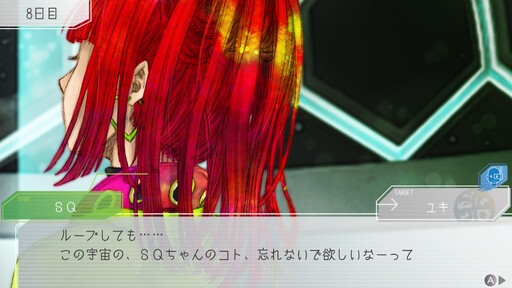
This is the event Tears of SQ, where we obtain her fifth (and final) note. The trigger conditions are: Obtained SQ’s third note, Yuuri is Gnosia, and SQ is crew aligned. In the first night event Yuuri visits her, she will notice that Yuuri is Gnosia because she senses Yuuri lying, but want to “make a deal” with them; then in the second night event, she murmured something like “just the two of us on this ship”, Yuuri responded with “Let’s do it”, and the event is on the rail. Then Yuuri would need to win the game to conclude the event, and if only Yuuri and SQ are left, there’s an additional choice (hold her) that will lead to the screenshot above.
There’s a sub-role in Jinro called Lover (恋人, koibito) that have a similar kind of win condition with this event. A sub-role is an additional role that is also randomly assigned to the player, works in addition to their original role, to add some little variation in large games. Not everyone will have a sub-role, and there will only be a handful of sub-roles in a game. The most common two sub-roles in Jinro are Decider (決定者, ketteisha, unbeknownst to this player, but their vote target wins the tie) and Authority (権力者, kenrisha, this player’s vote is worth two votes), and Lover comes next in third. While Decider and Authority only change one’s vote, Lover have some interesting effect:
- If the Lover sub-role is present, there will always be two players that have this sub-role (as opposed to other sub-roles where there will only be one); They know each other, and they have a dedicated night discussion channel.
- When one of them dies for whatever reason (whether be bitten, be hanged, or for any other reason), the other Lover will die together (for love, in lore).
- If the alignment of the two players are the same (eg. both are Human or both are Werewolf), dying together is all the effect they will have, their win condition will not change.
- On the other hand, when the alignment of the two players are not the same (eg. one is Human and the other is Werewolf), they will become a fourth camp, the Lover camp, whose win condition is now survive until there are four or fewer players alive, including the Lovers. Their original camp winning does not give them win. If the game is set too early, they lose; if they died early, they also lose; but at the moment there are four or fewer player alive, they win the game and all other camps lose. Think of this condition as something like Romeo and Juliet where the loving duo isn’t accepted in their original social group, with an additional revenge setting that “clear up all the obstacles for their love”, as described in the game description.
As one may see, the strategy of the same-alignment Lovers can be radically different with the different-alignment Lovers, and the special Lover camp win can only be obtained on the different-alignment ones. Because of this and the “survive until the end” condition, near the end game one would be cautious if there are potential Lover win situation, and in my experience only about 1% to 2% of the games are Lover camp win.
Back to the event, it is now clear that even if there’s no “die together” mechanic in GNOSIA, the final event condition is almost like a Lover camp win condition.15 Therefore, I may say the emotion build up in this event is so full that, when Yuuri hold her, the love SQ received from Yuuri overflowed and manifested as her tears (hence the event title Tears of SQ). The screenshot above is the dialog after that tear CG, where she says “After you like, loop… Please don’t forget like, the SQ of this universe, OK?” — and here I am, dedicated a whole subsection just for you 😃 The anime adaption of this event has some difference, partly because it is combined with another SQ event Fool and be Fooled, and partly because they are Guard Duty in the anime, there isn’t an implied Lover camp; But the last part of the adaption sell this face of SQ really faithfully, and I cannot ask for more.
Here’s a little segue: the screenshot above showed my character name as ユキ (Yuki), which comes from my handle in the Traditional Chinese Jinro community; choosing this character to be female and white also comes from this name. (Does anyone think of Yuki Nagato from this?) But I struggled a lot in this loop: This is a 13 player game chosen randomly by the system with Engineer, Guard Duty, Guardian Angel and I forgot how many Gnosia (probably 2 or 3), and I claimed Engineer to better hold the place. Unbeknownst to me, SQ is Guardian Angel, so a 13-player game that should end on day 6 is dragged into day 8, where the three people alive are a Definite Enemy me, a Definite Human SQ, and a Definite Human Setsu. Which means this Lover camp win is all thanks to SQ did not vote me out because of this event…
The Core Mystery: Parallel Universe Time Loop
Let’s talk about the BIG mystery. This spoiler shield is courtesy of Yuriko:
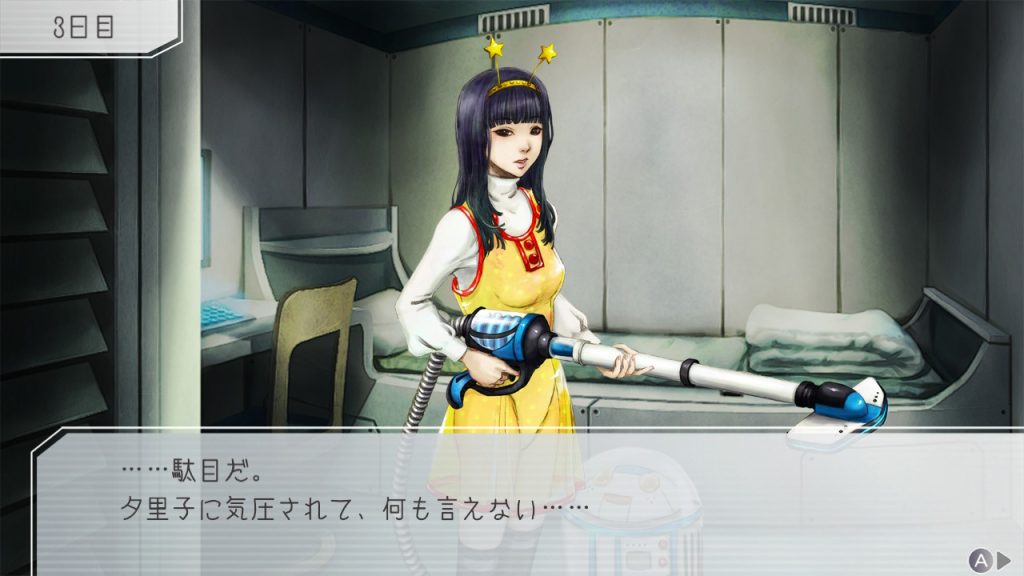
The pressure from Yuriko prevents you from saying anything…”
This is from the event Chaos.
Why she has this appearance is left for you to discover.
The Other SQ in the True End
Let’s fill this in first: the “[REDATED]” above where I write about SQ, is the Gnosia SQ that is actually her mom, Manan, which is exposed by Setsu in the True End. In the process, Setsu gave a “hypothesis” that SQ herself also suspected in Tears of SQ: In all the universes where “SQ” is Gnosia, that SQ is actually Manan who successfully transferred herself into “Body 511/SQ”. This explained the discrepancy I felt in game regarding SQ, since human SQ is quite different from the Gnosia SQ.
I’ll refrain from detailing how Setsu “tricked” Manan to “leave”; instead I’ll talk about how the people reacted in this part as a supplementary discussion:
- Raqio: As expected from them, they immediately get hold of the situation when Setsu takes out the Silver Key. They didn’t participate much the latter half of discussion, probably because whether this Manan goes through the portal or be cold slept, the Gnosia problem is solved.
- Jina: Although confused at first, once she understood what would happen, she can blurt out “no one will lose any sleep” to Manan when Manan said the mind transfer may damage her. THIS is how “emotional” she is. (And then “You’d be fine, too, Raqio.” immediately after. Talking about bad mouth lol Too bad this second reply is not included in the anime.)
- LeVi/Stella: When demanding LeVi to open up Kukrushka, Setsu also called her Stella, and especially “Please, Stella.” To me, in addition to address the identity of Stella, I think there is some nuance of “I’ll personally ask, not as a Lieutenant, but as a friend of Stella, please open the doll box.” I think this carry the same “friendliness” as Remnan treating LeVi as equal, which is why she quickly agreed, when she is also surprised at how Setsu knows Stella is her.
- SQ/Manan: Well, as a Chaotic Evil, I don’t think Manan will be mad about being tricked into a time loop. Although she would only discover that this is a trick after a long time.
- Speaking of trapping Manan into a time loop, there’s a suggestion saying that, the Kukrushka we met in the whole game (or at least the Gnosia ones) are all Manan.
- I could agree on some Kukrushka might be Manan. A hint on this is that: The event Nostalgic Flowers, the beginning of Loop 10, is where the very first time Yuuri met Kukrushka (and Jonas), where she gave Yuuri a flower hat. The original Japanese event name is “懐かしい君に花冠を”, literally translating to “Flower Hat to the Nostalgic You“. Why “You”? She already knows Yuuri, and after a long time finally meet Yuuri again, feeling nostalgic.
- But I don’t think all Kukrushka are Manan. Do note that, the Manan here in the True End is already a Gnosia, how can a parallel world Manan (in Kukrushka) be not Gnosia? I would think Jonas’ old love Arya would be a more fitting case.
- Setsu: After dealing with Manan, they said “I kept showing you nothing but my weak side. So I want you to see me getting things done for a change.” It is interesting to me that Setsu would want to show the “weak side” of them again after thing settled down. The two of them can only escape this time loop with each other’s help: Indeed, Yuuri obtained the detail about Silver Key from Raqio, but it is Setsu who endure the dull talk of Jonas to obtain the fact about Kukrushka, and also the name “Manan” only comes out a few minutes ago from their mouth. (This is different in anime, where anime Yuuri knows the name Manan from SQ.) I think that it is after these hundred odd loops did Setsu gained some kind of relationship beyond simply cooperation with Yuuri, that they can show this “weak side” of them to Yuuri.
Now, let’s start untangling this timey wimey loop:
The “First Night Victim”
When I mentioned that GNOSIA has no “First Night Victim”, I’m only talking about the repeating game loop. Later in the game, we found out that actually, after escaping Liu-An, Yuuri is seriously injured and is resting in the medical pod. But after one warp, the Yuuri in the medical pod disappeared, motivated other people to search for traces of Gnosia. Yuuri themself is the “First Night Victim”!
This is explained in the event A World Without Gnosia, which is entered by changing the game setting to 15 player and 0 Gnosia. The Yuuri eliminated by Gnosia left out a space for the Bug Yuuri to hijack their position. But in this world, the original Yuuri is still in the pod, and when two Yuuris acknowledged each other, the universe collapsed.
It seems like, just as Yuriko said, it is all because of Yuuri. After the “Yuriko clawing Raqio’s face” event (her sixth note), Raqio finally figured it out: It is because of fitting Yuuri into a universe, where Yuuri themself disappearing is the reason to search for Gnosia, that this Yuuri becomes the Bug. Tracing further back, it is the Silver Key on Yuuri that tries to fit Yuuri in because it wants information in the time loop. (Side note, although I don’t know at which point my “dislike” toward Raqio changed to “favor”, suffice to say these two segments (both last notes of Yuriko’s and Raqio’s) is a significant boost.)
Thus, in a certain loop, the spaceship passing though Allacosia got damaged by the debris, which injured Setsu; Yuuri then uses the Silver Key from Raqio in this loop (Raqio purposedly and openly left it in their room with a note is probably also a big favor boost for many of us) to transcend Setsu into the time loop, preventing their “death”. Then, in another certain loop, Setsu woke up the Yuuri in the medical pod, then after the game is set they gave a Silver Key to Yuuri. This is kind of a causality loop, in which Setsu gave the Silver Key to pull Yuuri into time loop, so that on a “later time”, that Yuuri can gave this Setsu the Silver Key to save them.
But just exactly which Yuuri does Setsu gave the Silver Key to? We know the “original” Setsu is the one in the damaged spaceship timeline, but which Yuuri is the “original” one?
The Special “Loop 1”
Note: as the preamble of this essay said, this is written when the anime info we get has only one promotional video. The premise of my inference in this subsection is false in the anime, but what follows may fit both.
There is one distinct feature in Loop 1 that is different in other loops:
In Loop 1, Yuuri is woken up from the medical pod.
Let’s enumerate the beginning of tutorial loops where there are some story progress:
- Loop 2: Yuuri just received Silver Key from Setsu, experienced looping, and found themself in the Main Control.
- Loop 4: The loop begins with the alarm of LeVi when Shigemichi is eating ramen before Yuuri in the Cafeteria.
- Loop 5: Starting in the Main Control again, with the first sight being Yuriko bluntly demands Yuuri be frozen.
- Loop 7: The loop begins with a close shot of a cat, which then revealed to be Chipie in the Lobby.
- Loop 8: The first Yuuri Gnosia game, which starts in Raqio’s room.
- Loop 10: The loop begins in the Viewing Lounge together with Jonas and Kukrushka.
- Loop 11: As part of Information Exchange, the loop starts with Setsu in a room.
- Loop 16: As part of tutorial of the Bug role, the loop also starts with Setsu in a room.
Other loops almost always begin in the Main Control, so one may think Yuuri comes out from the medical pod only in Loop 1. But as we know, the “original” Yuuri in the pod is eliminated by the Gnosia, so what is this Yuuri that comes from the pod?
Let’s also enumerates the scenes where Setsu is present beside the medical pod:
- In Loop 1, where they wake Yuuri up.
- In A World Without Gnosia, where they want to check on whether there is another Yuuri present.
- In the Normal End, where they goes through the portal with the medical pod.
The first one is the situation in question, while the universe is destroyed in the second one. Therefore, the source can only be the third one — which means, the “original” Yuuri comes from Setsu bringing the medical pod from A World Without Gnosia to the next universe!
There is one more thing that’s special about this Loop 1. To reach the True End, the player need to open a new save, starting Loop 1, and in response to Setsu’s “Understand?”, Yuuri says the experience they have had in Let’s Play. This filled the last entry in Setsu’s Silver Key, that Yuuri “carried over consciousness from another dimension.” A branching point right at the beginning of the story and directly going into the finale lets me think about works like Steins;Gate, that one must went through all the thing one experienced to know what to change in the beginning that can lead to the finale.
Fortunately, Yuuri and Setsu is still saving each other from their Silver Key, just like when they obtained Silver Key: This time, Setsu went into the portal to free Yuuri, and Yuuri comes back to give the last note of them to free Setsu.
An Astonishing Twist
Wait a minute. The time loop is courtesy of Silver Key, so one will repeat the same timespan many times. But this last time where Yuuri comes back to save Setsu is definitely not from the power of Silver Key; we may (meta-)describe this coming back to be the power from the other side of the fourth wall (because we opened a new save file). How is this justified?
Here, I think, lies one last astonishing twist of this game. Although this is currently my head-canon, I think this fills the last of the plot holes.
There’s a subtle clue coming from after Manan is disposed, when Setsu and the (new) Yuuri are about to go through “one last” warp:
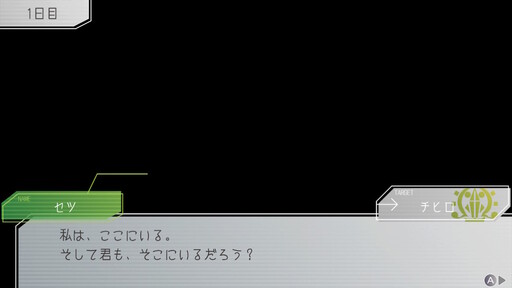
And you’re right there.”
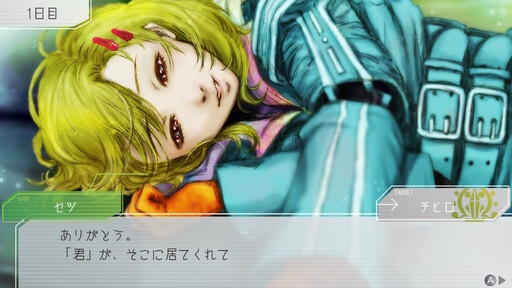
Thank ‘you’, for being there.”
Two simple sentences, yet the usage of “there” catches my eye. The new Yuuri is lying by their side, ready to go through the warp, but how Setsu addresses where Yuuri is at is the word “there”; The Japanese word used, そこ, carried additional meaning of “where the listeners (we) are”. With the additional quotes on “you” in the last sentence, it seems like Setsu is not talking to this チヒロ16, not talking to the previous ユキ, but the “you” across the fourth wall. How Setsu address the player character is also of note: when handling Manan in front of other people, they use the name of this save file, but when it’s just two of us alone, they use the name of the previous save file.
We may think that (and this is also alluded by Setsu themself: “I don’t think I’ll be able to see you again in the next loop.”), they intuitively understand that this ユキ coming as チヒロ to save them, will leave this universe after this warp. “Here” is never where this ユキ belongs to, it’s “there”; so they want to pour out all the emotions they have after all these hundred-odd loops together now. All of that emotions accumulated into this last sentence: “Thank ‘you’, for being there.”
In other words, this one last astonishing twist of the game GNOSIA, is:
“Yuuri” already transcended across the fourth wall, became Gnos, but in order to save this Setsu that looped with them for all these hundred odd times, recalculate themself into the world to fulfill the note of Setsu’s Silver Key. This last note Setsu accumulated really means that: Yuuri has become Gnos, comes from another world, and this last time Yuuri comes here does not uses the power from the Silver Key.
This twist would explain the following things:
- We know that Yuuri is the First Night Victim. In addition to the consistency (no doppleganger) in-universe, Yuuri being Gnos is the direct consequence of this fact. Quoting Yuriko, “Gnos is cyberized humankind”, and Gnosia wants “to send more and more minds to Gnos.” Yuuri literally becomes Gnos when they fall victim to Gnosia at the beginning.
- Note that when looping with the power of Silver Key, only the consciousness loops, the body isn’t. No matter the fate Yuuri and Setsu encounters in one loop, they will use their functional body in the next loop. Setsu is able to “escape” death from the Allacosia accident; and even if the universe is destroyed by Bug, by slime, or by Kukrushka, they still comes back to next loop in whole. Setsu would undoubtly using their original body in that loop, but what about Yuuri? They already disappeared because they fall victim to Gnosia. This is explained by the “recalculation” mentioned by Jina. She said, although she can meet her cyberized mother again, “it’s not the ‘Mother’ I knew. Just the recalculated version of her.” In Yuuri’s case, this recalculated body is what they use to interact.
It seems like Setsu is addressing “you” across the fourth wall. What if they actually are? What prevents us to go one more step, speculating “The cyberized Yuuri is actually the player”? Gnosia Jina once said, “Those who are eliminated disappear from this universe… But they simply go on to another world.” This “across the fourth wall” explanation gives one possibility to where “another world” is at — where we, the players, are. This also explains that, in this final act, Yuuri is using the power of Gnos, across the fourth wall, to save Setsu, by opening a new save file. Yuuri is the player all along! (Yes, this is the reason I intentionally use “Yuuri” throughout this essay to refer to the player character, to initiate this statement that is obvious to us Gnos, but is actually a crucial element of the game story.)
In a really roundabout way, this setting reflected one core part of the RPG genre: an external player comes, playing the role of a being in the game world, and made meaningful influence to it. All 15 characters in this story (yes, including Manan) will remember that one time, on the spaceship D.Q.O. exiting Liu-An, they’ve met this person, and although not directly (or perhaps unbeknownst to them), they changed their life, however slightly.
Some of the reader might have seen similar concept used in other games, for example in the AI: THE SOMNIUM FILES series I mentioned in passing; And if you know me from reddit, you might know that I am a really big fan of Kotaro Uchikoshi’s work, and this “player directly intervenes the story” trope is a recurrent part in his work. Comparing with those works that (relatively speaking) smashes the fourth wall, the way GNOSIA did is a relatively light knock on it, and I think this is a refreshing experience.
GNOSIA is a special game to me. It made me revisits the time playing Jinro with all those people across the Internet, with a sci-fi twist that I’m always loving. For other people, they get to experience playing games like Werewolf with a really good story. The anime adoption is received quite well, and I will recommend one go get the game if they think the story is interesting to them.
Footnotes
- This is CNY 2025, not CNY 2026, as mentioned in the beginning. ↩︎
- Loop 1 of the game is designed to go like this: Raqio is voted by the other 3 people, Jina is eliminated overnight, and player now need to decide should they trust Setsu or SQ. Setsu is by the player side from the beginning, so if they gained the player trust SQ will be voted out, revealing she is the Gnosia. On the other hand, although Jina will always claim Engineer as introduction in Loop 2, whether she is Gnosia is still random. ↩︎
- Interestingly, there are unused text for all the character claim to be Guardian Angel and Gnosia. Maybe the option of claiming to be one was in consideration? ↩︎
- In Jinro jargon this strategy is called Roller (and simplified to R in my community), probably taking from the image of road roller flattening all the things on its way. This is actually the intent of the skill Freeze All, but it is simplified to just freeze all alive Engineer/Doctor (with the additional effect of actually tending to vote off them if the proposal is rejected), and because this simplification is quite powerful, it required Logic 30 to use; even when it is Raqio who uses this skill, the success rate is not good. ↩︎
- I have once be in a one Diviner game where 5 players claim Diviner. In GNOSIA, system-wise even if the player is Gnosia, a fifth Engineer claim is forbidden, but it is not hard to see if this is not the case how the player can claim a fifth Engineer. Granted, this is a really bad strategy for the Gnosia/Werewolf side (if you did this on Loop 8, Raqio will scold you), but it is a curiosity nonetheless. ↩︎
- I originally thought this series of jargon starts from the verb “registering” (which is what I wrote in the original essay back when it was published), but after one of our member got curious about the origin, I dug into the old discussion post and past game records of a closed server with Web Archive, and determined that the original term should be “the test of false Diviner”; other jargons would then derived from this. I’ve also modified my original essay to reflect this finding. ↩︎
- In recent years there are servers that host “long term Jinro” games, which follow similar long term strategy board game convensions used in Diplomacy and the like: game rounds lasts for one or two days, and players discuss and act within the duration of the round. Conversely, the variant described here is then called “short term Jinro“. Interestingly, this often makes a game “day” lasts more days IRL. ↩︎
- This reddit post analyzed the code behind what is a “lie”. It provides a pretty good insight on how a game system revolving around dialogue interactions works. ↩︎
- In Jinro, there is a separate chat room for the eliminated players. Since in the game setting they are “dead”, this place is colloquially called “Heaven”. Players in Heaven get to see who has which role, and can discuss both on how was their performance and/or how the game is progressing. ↩︎
- There is one podcast I’ll use as a kind of “definite name source”: this one from Yui Channel interviewing the developers in 2020. This source is directly cited in Japanese wikiwiki site, and indirectly cited via a reddit post in English fandom site. The part they discuss about character names is about 40 minutes in, but not all characters are mentioned, and I will also only list the name source mentioned in it. ↩︎
- In the original Traditional Chinese version of this essay, I used “TA”, the non-specific-gendered third-person pronoun started from mainland China, as the pronouns of the Han gender, which kind of stood out in a passage full of Chinese characters. In Chinese, the character “她” (with radical 女 indicating things about women) is created around 1920 to translate the third-person pronoun “she/her” in English (and similar pronouns in many European languages); The original third-person pronoun “他”, which originally isn’t gendered, now have the gendered meaning of “he/him”. There is still debate on whether Chinese should use the gendered pronoun like English do or not, but probably because I learned English at a pretty young age, the concept of gendered pronoun is wired deep in my mind, and I frequently use “她” when “appropriate” even when I’m not writing English related texts. (This also have an effect on my view of non binary genders, but that’s another long story.) This essay is no different, so when I want a different “gendered” pronoun to use on the “agendered” Han, I have some difficulty. In the end I decided on the “TA” usage, which comes from the pinyin of the common pronounciation of the various third-person pronouns in Chinese. As to pronoun for Yuuri and/or the player, due to the androgynous nature of Yuuri in the anime and the ambiguous nature of player, I settled on “他” in Chinese, using the old non-gendered meaning; with my intention to keep neutral on this, I’ll use “they/them” for Yuuri in this translation. ↩︎
- In my original essay, I had a footnote here saying “Now we have neuro-sama, do we come closer to this?”, but the recent development of Moltbot social network probably means we may be a lot closer than we think. ↩︎
- Regarding to the romance scene here, although I don’t get to see this first hand because my character is female, watching other people play this part gave me the same feeling with Sora: they both have the “imitating youth romance from (probably) fictional works” vibe despite the appearance of an adult woman. (Considering the “age” of Stella is two years “older” than the “age” of Sora, I would say this is cuter.) ↩︎
- Fun fact: In the original Japanese, the event title Citizen Slime is 国民粘菌 (the English title is a pretty literal translation), but aside from indicating the slimes are also the citizen of Comet’s origin planet, this title is actually a Japanese pun on 国民年金 (National Pension). ↩︎
- The reason it is four players in Jinro rather than two as in this GNOSIA event is that, there are advanced roles that cannot stand alone by themselves, requiring another role to be alive as well, just like Lovers require each other to be alive. As Lover is a subrole, the player will still have a normal role, and the win condition requiring just four players gives these role a chance to win as Lover. ↩︎
- It should be no surprise that this name comes from Chihiro Fujisaki I mentioned above, given that I use him as SMS avatar almost everywhere. This Chihiro is set to be Male and color Chartreuse, with the color coming from his uniform. Maybe one day I’ll use this character to see male character events myself. ↩︎